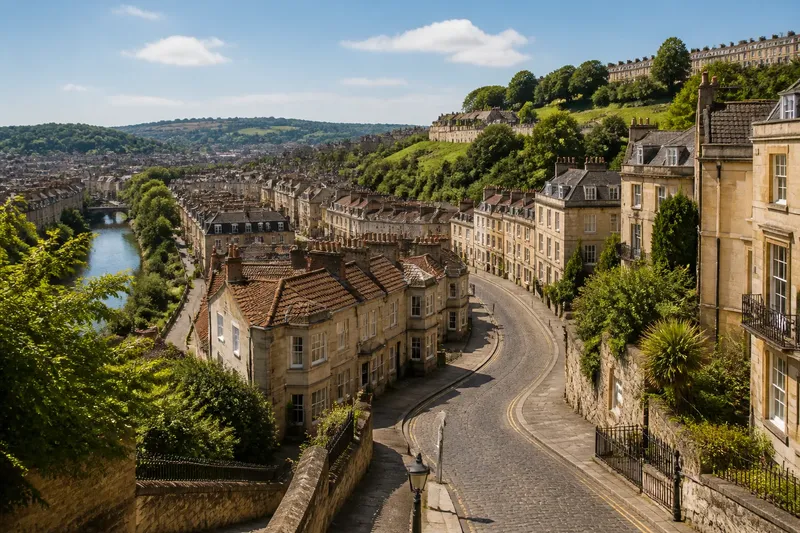
Reading the Layers in a Southern City Place Name
Reading the layers in a Southern city place name helps you spot language clues, separate later changes from older traces, and know what evidence to seek.
A street sign reading “Barrack Street” or “Little Lonsdale Street” can preserve several layers of a Southern city’s past, but the name alone cannot tell you exactly how those layers formed. Reading the layers in a Southern city place name means treating its sounds, spelling and use as clues, then checking each possible explanation against other evidence.
Start with the name as it appears now
Write down the full name, including its generic term: street, creek, hill, reserve, road or square. The generic can suggest what kind of feature the name first described, while the distinctive part may have changed in form or meaning. Neither is conclusive; an old creek name, for instance, may now label a road far from the watercourse.
Note the exact spelling and pronunciation used locally. A sign, council map, street directory and local speech may differ. Record those differences rather than silently choosing one version. A changed spelling can reflect ordinary sound shifts, a spelling convention or a deliberate renaming, and those possibilities call for different evidence.
Then locate the named feature on a current map. Ask what lies around it: a shoreline, railway, market, former boundary, institutional site or older settlement. This is not proof of the name’s origin, but it helps you frame a useful question. “Why is this road called Market Street?” is more answerable when you know whether a market or market route is nearby.
Listen for language clues without treating them as translations
Southern cities often carry names shaped by more than one language. Indigenous names may remain alongside names imposed by settlers, while migrant communities, institutions and businesses can leave further traces. A name’s present form may be the result of transcription between languages, local pronunciation or later standardisation.
Look for patterns rather than guessing from a single syllable. Does the same element recur in nearby names? Is it attached to a landform or water feature? Does a reliable language source identify the form and explain its meaning in context? A resemblance to a familiar word is a prompt for checking, not a translation.
Be especially careful with Indigenous place names. The spelling on a street sign may represent only one written form, and a name may have meanings or associations that cannot be reduced to a simple English gloss. Consult material produced by the relevant Traditional Owners or Indigenous language organisations where available. If local sources differ, report the difference clearly rather than presenting one account as settled.
Separate a linguistic clue from a historical conclusion
A name can point towards a possible history without confirming it. “Chinatown”, for example, signals a later community label, but does not establish when the name began, who used it first or how residents described the area. A name associated with a person does not by itself show why that person was commemorated, or whether the feature was named at the same time as the surrounding development.
Build claims in layers. First state what can be observed: the name’s current form and location. Next identify a plausible linguistic or geographic clue. Then distinguish what would require documentary support, such as the date of adoption, the person or community responsible, and the reason for the choice.
Useful evidence can include council naming records, subdivision plans, historic maps, directories, newspapers and local archives. Compare sources that serve different purposes: a map may show when a label appeared, while a council record may explain who approved it. A later history book can point towards records, but do not assume its explanation is definitive without checking how it was reached.
Trace how spelling and use may have shifted
Search for variant spellings, former names and abbreviations. Older maps may use a different form from current signage; directories can show when a label became common; minutes may record a formal change. Keep the dates attached to each version, since a name’s first appearance in one source is not necessarily its first use.
Also ask who used the name. Residents, mapmakers, officials and visitors may have used different labels for the same place. An official renaming can coexist with a persistent local name, while a label created for a map may not have been widely spoken. Place names are part of daily use as well as the record, so a single archive can miss that distinction.
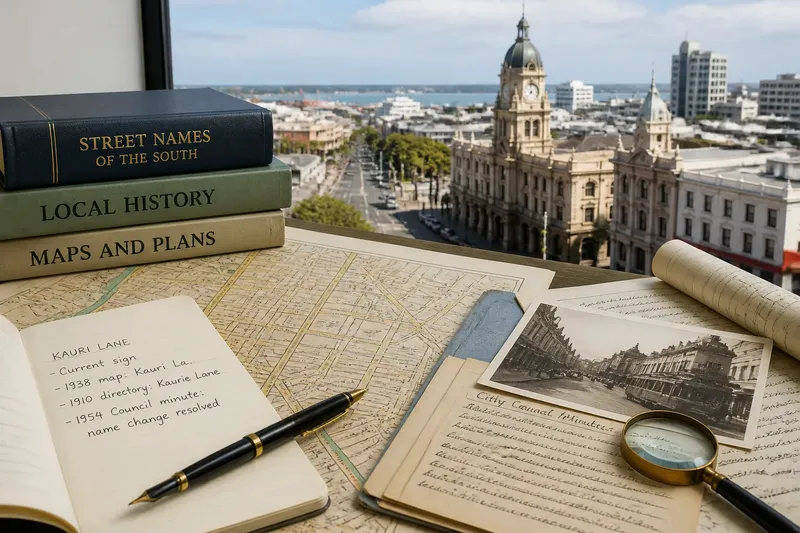
Say you are tracing a fictional “Kauri Lane” in a coastal city. You find the name on a current sign, then spot an older map with a different spelling and a council minute recording a later change. The sound of “Kauri” may prompt a language question, but the documents establish only the spelling sequence and formal decision; you would still need a suitable language source to make a claim about origin or meaning.
Which evidence helps read a place name?
Does a familiar word reveal where a name came from?
Not on its own. Similar sounds can arise by coincidence or through altered spelling, so check the name’s earliest forms and a credible source for the language concerned.
How can you tell whether a name was officially changed?
Look for council or local authority records, then compare the recorded change with maps and directories from different periods. A new sign may reflect a formal decision, but it may also simply replace an older sign.
What if local sources give different meanings?
Keep each account attached to its source and explain where they differ. For Indigenous names in particular, seek guidance from the relevant Traditional Owners or language organisation instead of choosing the gloss that seems easiest to fit.
Can an old map prove a name’s origin?
An old map can show that a form was in use by the time it was made, but usually cannot establish who coined it or why. Use it alongside records that explain naming decisions and sources that address the language itself.
Present the result with its limits visible
A clear account separates observation, interpretation and confirmation. You might write that a name appears in a map from a particular period, that its form resembles a word identified in a named language source, and that the records you consulted do not establish who selected it. This phrasing gives readers useful information without turning a clue into a settled story.
For your own notes, keep a small record of the name’s versions, the source and date for each, the feature’s location, and what each source actually supports. Reading the layers in a Southern city place name is most useful when uncertainty is specific: you can show what the name preserves, what it suggests and which question remains open.